Big ideas deserve bold learning. Book a meeting and let’s get started.

The Fourth Industrial Revolution Has a Gut Problem

Posted by:

|

On:

|

, , , , , ,

We like to talk about “industrial revolutions” as if they’re clean breaks with the past: steam, electricity, computing, AI. In reality, each wave carried the same pattern forward: innovation without people at the centre, value and wealth accumulating with a small group, and everyone else left to adapt to the consequences.

You can see this clearly if you look backwards from where we are now: in the early days of the AI-driven fourth industrial revolution, to the Green Revolution and the quiet revolution inside our own bodies: the gut.

The Green Revolution: More Grain, Less Diversity

The Green Revolution of the mid-20th century had a clear, urgent goal: grow more food, fast. High-yielding varieties of wheat and rice, synthetic fertilizers, pesticides, and irrigation transformed agriculture in India, parts of Latin America, and some Asian countries. Yields increased significantly, and in many places, deaths from famine and severe hunger dropped. PMC+1

This matters. It would be dishonest to romanticize pre-Green Revolution agriculture when millions were at real risk of starvation.

Article content
Younger generations have forgotten effects and impacts of famine because we haven’t had to contend with it for a while as a direct effect of green revolution

But the story didn’t stop with yield curves.

Intensive monoculture and input-heavy farming have contributed to:

  • Loss of biodiversity – Fewer crop varieties, less resilient ecosystems, and a narrowing of the genetic base we rely on for food security. Chatham House+1
  • Environmental stress – Agriculture today drives an estimated ~80% of biodiversity loss, ~80% of land-system change, and about 70% of global freshwater withdrawals. BloombergNEF
  • Dietary simplification – As a few commodities (wheat, rice, corn, soy, sugar, industrial oils) took over fields, they also took over plates, replacing regionally diverse, seasonal food cultures. Chatham House+1
Article content
Panama Disease threatens monocultures like Cavendish Bananas grown in South America for North American consumption

Some regions benefited enormously from the Green Revolution. Others — including many countries in parts of Africa — did not see the same gains in yields or infrastructure, reinforcing global inequalities in who eats, who profits, and who remains food-insecure. PMC+1

The result: we reduced hunger, but we also reshaped ecosystems, cultures, and bodies in ways we are still trying to understand.

The Irony of “Going Back” to Seasonal, Local, Organic

Fast-forward a few decades.

In many urban centres, especially among wealthier consumers, there’s a growing desire to “go back” to seasonal, local, organic, chemical-free foods. Ironically, this is often marketed as a premium lifestyle — something you buy through expensive farmers’ markets or curated meal boxes. But for generations, many communities didn’t need labels like “organic” or “farm-to-table.” Foods were seasonal because there was no cold chain. They were local because there was no global commodity supply chain. Food traditions evolved around what the land could offer at specific times of year.

Our bodies and microbiomes adapted to that rhythm. We broke that rhythm in just a few decades — not because people asked for it, but because it made sense for industrial agriculture, global trade, and shareholder returns.

The Microbiome: The Quiet Collateral Damage

Inside every one of us is another system that has gone through a silent revolution: the gut microbiome.

A rapidly growing body of research links the Western-style diet — high in saturated fat, animal protein, sugar, and ultra-processed foods, and low in fibre and plant diversity — to reduced microbial diversity and a state of “dysbiosis” in the gut. BioMed Central+2Frontiers+2

This shift in the microbiome is associated with a wide range of chronic conditions, including:

  • Inflammatory bowel disease (IBD)
  • Irritable bowel syndrome (IBS)
  • Obesity and metabolic syndrome
  • Type 2 diabetes
  • Cardiovascular disease

The numbers are sobering:

  • IBS affects roughly 11–14% of adults globally, depending on how you define it. Lippincott Journals+2ScienceDirect+2
  • IBD (Crohn’s disease and ulcerative colitis) has risen sharply. Global cases increased from about 3.3 million in 1990 to nearly 4.9 million in 2019, and incident cases have almost doubled by 2021 in some analyses. PubMed+3BMJ Open+3Springer Link+3

These are not just “first world” issues anymore. As countries industrialize and diets shift toward ultra-processed, low-fibre patterns, IBD and IBS are rising in newly industrialized regions across Asia, Latin America, and Africa — the same places that were once framed as beneficiaries of agricultural modernization. Nature+2BioMed Central+2

In other words: we solved one crisis of hunger while slowly building another crisis in chronic disease. We didn’t set out to destroy biodiversity, culture, or microbiome health. We just didn’t centre them in the design.

Now Comes AI: The Next “Fertilizer”

Today’s language around the “fourth industrial revolution” will sound very familiar to anyone who has studied the Green Revolution:

  • More efficiency
  • More productivity
  • More optimization
  • At scale, in real time, across everything

AI is becoming the fertilizer and high-yield seed of our era — not for crops, but for decisions, workflows, and attention. If we repeat the same pattern, we’ll see: Concentrated gains in wealth and power for some and diffuse, poorly understood externalities for everyone else.

You can already see early signals:

  • Workers facing algorithmic management while job quality stagnates.
  • Artists negotiating with opaque AI systems trained on their work.
  • Students and teachers adjusting to AI tools without clear frameworks for learning, autonomy, or consent.
  • Health systems flirting with AI decision-support without fully addressing bias, accountability, or long-term safety.

We often respond by saying: “We need ethical AI.”

That’s true. But if we’re not careful, “ethical AI” will become what “sustainable agriculture” sometimes became: a label on the side of the system, not a redesign of the system itself.

The Missing Piece: People as More Than Units of Productivity

This is where I think we can learn from people working in international development who are trying to rewrite the script.

Fatema Z. Sumar, Executive Director of the Harvard Center for International Development (CID), describes their mission as reimagining international development so that “where others see poverty, we see potential” and building societies where people can reach their full potential and thrive. Harvard Kennedy School+1

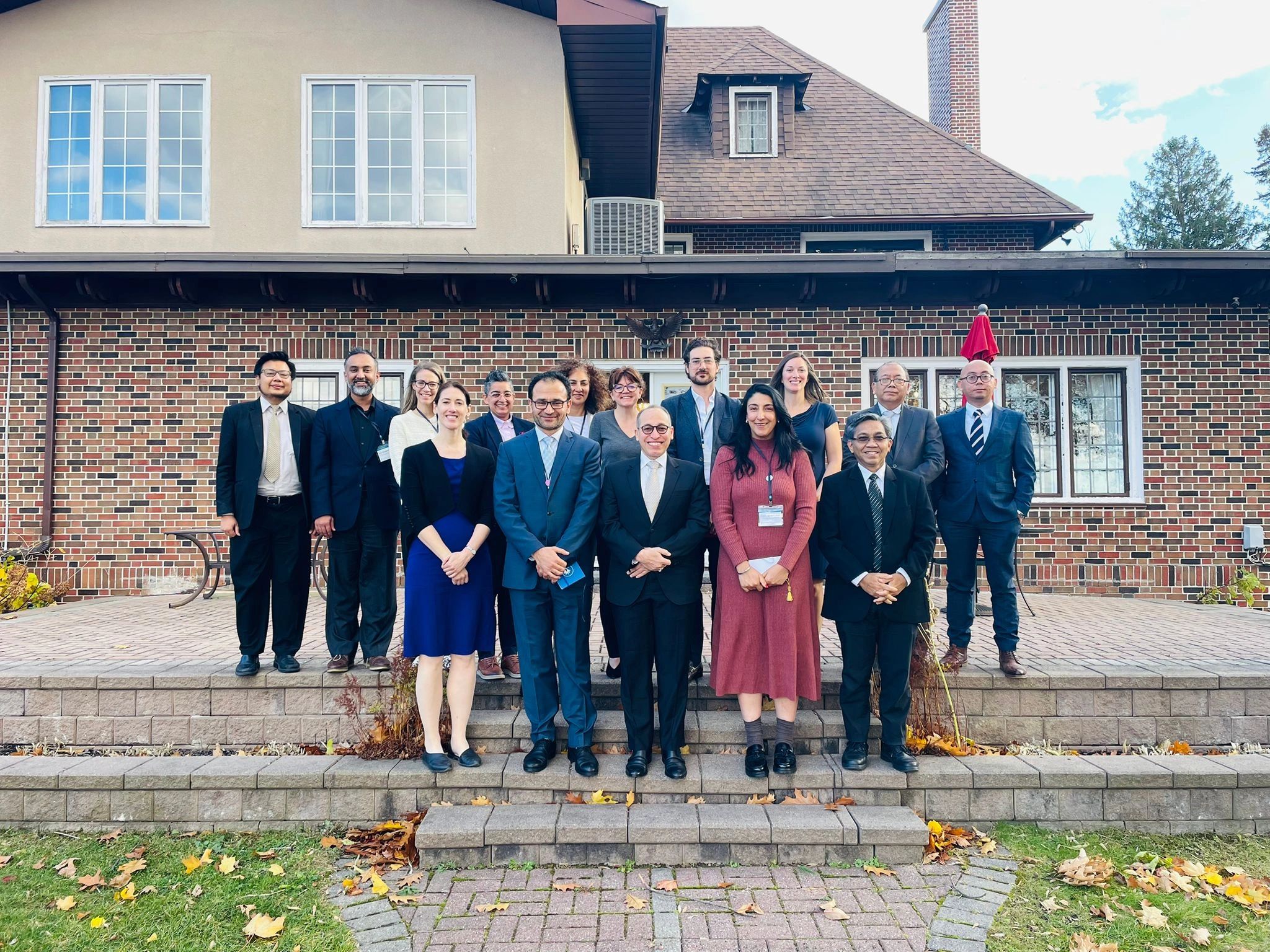
That shift — from poverty to potential — sounds small, but it’s profound. Thanks to Aga Khan Foundation Canada for inviting this amazing speaker who ignited lots of interesting ideas on what International Development means.

For decades, we’ve measured success in terms of:

  • GDP
  • Productivity per worker
  • Hours worked
  • Return on investment

Those metrics matter. But they’re incomplete. They don’t capture:

  • Biodiversity loss in our fields and forests
  • Changing nature of our everyday living
  • Cultural loss in our kitchens, festivals, art, and languages
  • The erosion of time for care, creativity, and community

When we talk about AI and the fourth industrial revolution, we often default back to the same narrow indicators: productivity, cost savings, “skills for the future of work.” If we’re serious about learning from past revolutions, we have to widen the lens.

The Fourth Industrial Revolution Needs Better Questions

The story of the Green Revolution and the microbiome is not a cautionary tale about “technology is bad.” It’s a reminder that:

  • What we centre determines what we see.
  • What we measure determines what we fund.
  • What we ignore silently shapes bodies, ecosystems, and futures.

Designing for a Different Outcome This Time

So what would it mean to keep people at the centre of this next wave, instead of using them as inputs to an efficiency engine?

A few questions I’m sitting with:

  1. Whose bodies are we optimizing for?
  2. Whose cultures and ecosystems count as “data”?
  3. Who owns the upside? Who absorbs the downside?
  4. What would a “zone of potential” look like in AI deployment?

If we centre only productivity and profit in AI, we’ll get those too, and we’ll wake up in a decade wondering why our institutions feel hollowed out, our cultural ecosystems feel thinner, and our bodies and minds are struggling to keep up.

We can do better this time. A truly “advanced” industrial revolution isn’t one where the tech gets smarter and the people get sicker, lonelier, or more exhausted. It’s one where innovation and human flourishing move together.